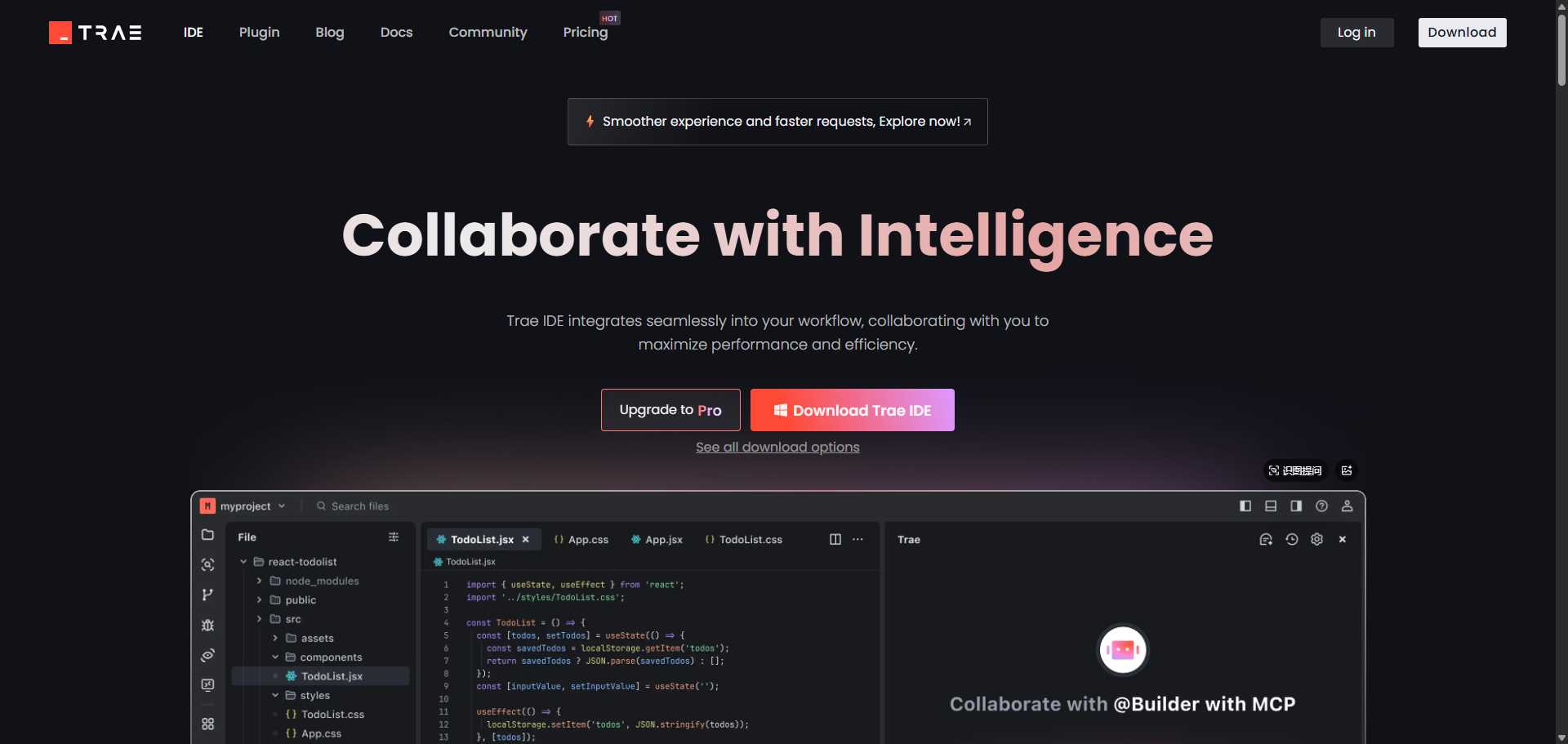
AI-native IDE with intelligent code generation, automated refactoring, and natural language commands.
Code Writing
Image Generation
Text Generation
Trae is an AI-native integrated development environment (IDE) that combines code editing with deep AI integration. It features intelligent code generation, automated refactoring, natural language commands, and context-aware assistance throughout the development workflow.
Preview
Introduction
Functional characteristics
Generates and refactors code from natural language prompts in both English and Chinese.
Offers real-time, context-aware code completion and suggestions within the editor.
Features a Builder mode that autonomously decomposes tasks and builds full projects end-to-end.
Supports multi-modal input, allowing users to upload images (e.g., design mockups) for code generation.
Provides intelligent debugging by analyzing error logs and suggesting fixes.
Application scenarios
Rapidly prototyping full-stack web or mobile applications from a simple idea description.
Automating repetitive coding tasks like writing boilerplate, unit tests, or CRUD operations.
Debugging and optimizing existing codebases by explaining issues and proposing solutions.
Translating UI designs from images or sketches into functional frontend code.
Applicable population
Software developers of all levels, from students and beginners to experienced professionals.
Teams looking to accelerate their development cycle and reduce time-to-market.
Pricing method
Trae is currently free to use, with no paid tiers or usage limits announced as of July 2026.
Supported languages
The IDE interface and AI interactions support both English and Chinese.
The underlying AI models can work with a wide range of programming languages, including Python, JavaScript, Java, C++, Go, and more.
Technical highlights
The international version leverages top-tier models like GPT-4o and Claude 3.5 Sonnet.
The China-specific version uses ByteDance's proprietary Doubao-1.5-pro and supports DeepSeek R1/V3 models.
It features deep integration of the AI agent into the IDE, providing superior context awareness compared to simple plugin-based assistants.
Usage
Available as a desktop application for macOS, Windows, and Linux.
Update record
Recent updates have focused on platform expansion, with the official launch of a native Linux client in early 2026.
New features include Remote-SSH support for remote development and the ability for users to connect custom AI models via API.