OpenCode open source AI code programming assistant, terminal native intelligent programming and code generation tools- ChooseAI Tools
OpenCode
Open source AI programming assistant, terminal desktop IDE multi-terminal collaboration code
AI Code Assistance & Testing
Low Code/No Code
Code Generation
Full-Stack Development
Open Source Project Installation
Developer Ecosystem
OpenCode is a fully open source AI programming agent platform, using MIT license, support terminal TUI desktop applications and IDE extensions three ways of use. The core concept of the product is client-side open source model self-selection, not bundled with proprietary large model services, allowing developers to freely connect to more than 75 LLM providers such as Claude GPT Gemini GLM DeepSeek. Five free models are included, including GPT-5 Nano Big Pickle GLM-4.7 Grok Code Fast 1 and MiniMax M2.1, lowering the threshold for use. Build mode has full tool permissions to execute file editing and Shell commands,Plan mode is read-only state to focus on task planning to avoid misoperation. Support macOS Windows and Linux all platforms, through Homebrew Winget Scoop npm and other ways to install. Fully localized No code data is stored, all information is transferred only locally between the device and LLM provider for privacy and security. With over 70,000 monthly active users and 650,000 active users, GitHub has become the benchmark for open source AI programming tools.
Preview
Introduction
functional characteristics
Build and Plan modes are supported: Build mode has full system permissions and can execute file editing and Shell commands;Plan
The mode is read-only, focusing on task planning to avoid misoperation.
Compatible with over 75 large language models, including Claude, GPT, Gemini, GLM, DeepSeek
It does not bundle proprietary model services and allows free switching between cloud and local models.
Deep integration with multilingual server protocols (LSP) such as Rust, Swift, Terraform, TypeScript and
PyRight, improve code interaction efficiency.
application scenarios
Daily software development: Automatically generate, debug, and test code in Build mode.
Project analysis and refactoring: Use the Plan pattern to safely understand unfamiliar codebases and develop refactoring scenarios.
Multi-session parallel development: open multiple session windows at the same time to handle different tasks such as database design and front-end development.
Remote development: core services are deployed on remote servers through client-server architecture, efficiently coded locally.
suitable for the croud
Senior developers and technical teams seeking high levels of control and auditability.
Personal or business users who have strict requirements for code privacy and data security.
type of pricing
Completely open source, free to use, modify and distribute under MIT license; built-in GPT-5 Nano, Big
Pickle, GLM-4.7, Grok Code Fast 1 and MiniMax M2.1 are five free models.
Requirements can be described in natural language (such as Chinese and English) to drive AI to generate code.
technical highlights
Based on open source architecture, users can freely access any LLM provider without relying on a single underlying model; through LSP and MCP
The protocol implements efficient collaboration with code libraries and tool chains.
With a "privacy first" design, all code and context data is only local to the device with user-specified LLM
The platform does not store any user data.
usage mode
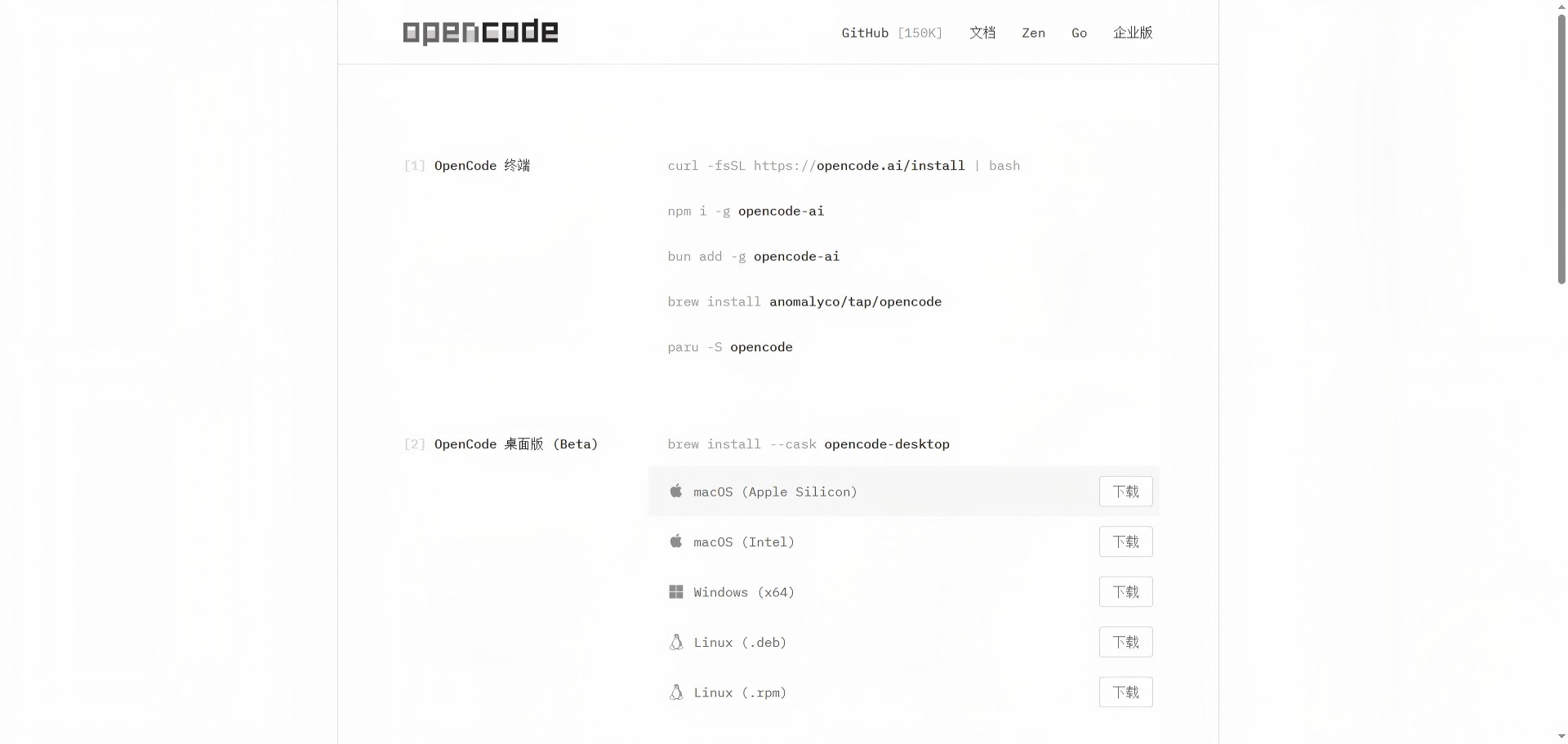
Support macOS, Windows and Linux platforms, provide terminal TUI, desktop application and IDE plug-in three ways of use.
Can be used as a plug-in for VSCode, Cursor, JetBrains, Zed, Neovim, Emacs and other mainstream editors, and supports
Homebrew, Winget, Scoop, npm and many other ways to install.
update history
January 2026 v1.0.216 released, fixed HTTP unauthenticated due to default startup
Remote Code Execution Vulnerability (CVE-2026-22812).
At the beginning of 2026, support for Kimi 2.5 and other domestic large models was added, and multi-session management and AgentClientProtocol (ACP) were optimized.
compatibility.